
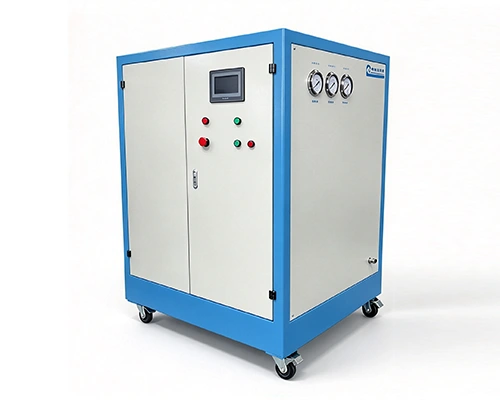
Shandong Hengrong Hydraulic-driven Liquid Booster has a maximum power of 55 kW. It can directly boost low-pressure gas to high pressure, with a maximum pressure up to 600 MPa. Adopting hydraulic drive, the equipment features easy connection, high cost performance, high efficiency and large flow rate. It has a wide range of applications and meets the high-pressure and high-flow requirements of various liquids in multiple industries. For special working conditions with larger flow rates or higher pressure, please contact our company.
Technical Specifications:
- Pressurization process: Gas pressure acts on the piston of the booster chamber. At the same time, hydraulic oil pressure acts on the hydraulic piston of the drive chamber. Driven by hydraulic force, the gas is compressed during the stroke and discharged from the high-pressure cylinder. During operation, the forces acting on the pistons at both ends and the force on the hydraulic cylinder piston maintain dynamic balance.
- The pressurization process adopts a long-stroke and low-frequency design. The gas is cooled while being compressed, which avoids excessive temperature of outlet gas and reduces equipment wear.
- The piston is fitted with multiple seals for a leak-free design, preventing the gas in the pressurizing chamber from being contaminated by hydraulic oil in the drive chamber.
- When the set pressure is reached, the booster shuts down automatically without additional energy consumption. It will automatically restart to supplement pressure if the pressure falls below the set value.
- If the oil tank liquid level is too low, the liquid level relay sends a signal and the system stops automatically. If the oil temperature of the tank is excessively high, the oil temperature relay sends a signal to trigger automatic system shutdown.
- The equipment requires a 380V three-phase four-wire power supply.
- Two-stage pressurization: Its working principle is similar to that of a single-stage booster. The main difference is that the cylinder barrel of the second-stage booster is smaller than that of the first stage (different pressure ratio). The gas undergoes secondary pressurization to boost low-pressure gas to a higher pressure, and an interstage cooling device is equipped.


